

Key Contributions of Al-Razi:
Distinguishing Smallpox and Measles:
Al-Razi wrote Kitab al-Judari wa al-Hasbah, a work that was a masterclass in clinical medicine and remains the earliest known detailed description of smallpox, distinguishing it from measles.
Medical Encyclopedia:
He authored Al-Kitab al-Hawi, a 23-volume encyclopedia that became a fundamental medical textbook in both the Islamic world and Europe for centuries.
Advocacy for Clinical Studies:
Al-Razi suggested a rudimentary form of a controlled study to test new treatments, indicating an early understanding of scientific methodology in medicine.
He is also recognized for founding the first psychiatric ward in Baghdad, demonstrating his interest in the medical treatment of mental illnesses.
Hospital Site Selection:
Al-Razi developed an innovative method to select the healthiest site for a new hospital by placing pieces of meat in different locations and choosing the site with the least decay.
Abu Bakr Muhammad Ibn Zakariya Al Razi was born in Al Rayy, a town on the southern slopes of El Burz mountains near present-day Tehran, Iran, in the year 865 AD (251 Hegira). His early interests were in music. He then started studying alchemy and philosophy.1 At the age of thirty, he stopped his work and experiments in alchemy due to eye irritation by chemical compounds he was exposed to. Among his discoveries in alchemy, he is credited with the discovery of sulfuric acid and ethanol.
His teacher in medicine was Ali Ibn Sahl Rabban al-Tabari, a physician and philosopher born to a Jewish family in Merv, Tabaristan of modern-today Iran. Ibn Rabban converted to Islam during the rule of the Abbasid Caliph Al-Mu’tasim who took him into the service of the court, in which he continued under the Caliph Al-Mutawakkil. Al-Razi studied medicine and probably also philosophy with Ibn Rabban. Therefore, his interest in spiritual philosophy can be traced to this master. Al Razi quickly surpassed his teacher, and became a famous physician. He was appointed as director of the hospital of his hometown Al Rayy during the reign of Mansur Ibn Ishaq Ibn Ahmad Ibn Asad of the Samanian dynasty. Al Razi’s fame reached to the capital of the Abbasids. He was called upon by Caliph Al Muktafi to be the chief director of the largest hospital in Baghdad. Al Razi is attributed with a remarkable method for selecting the site of a new hospital. When the Chief Minister of Al Muktafi, named Adhud Al Daullah, requested him to build a new hospital, he had pieces of fresh meat placed in various areas of Baghdad. A few days later, he checked the pieces, and he selected the area where the least rotten piece was found, stating that the “air” was cleaner and healthier there.
Following the death of Caliph Al-Muktafi in 907, Al Razi returned to his hometown Al Rayy. He was in charge of the hospital there and dedicated most of his time for teaching. It is said that he had several circles of students around him. When a patient came with a complaint or someone from the laity had a question; it was passed to the students of the “first circle”. If they could not give an answer, then it was passed to those in the “second circle” and so on. If all failed to give an answer, then it came to Al Razi who gave the final answer.
Al Razi was quite generous and charitable for his patients, treating them in a quite humane manner, giving them treatment without charging them. In his latter years, he had cataract in both eyes and became blind. He died in Al Rayy on October 27, 925 at the age of 60 years.
He wrote more than 224 books on various subjects. His most important work is the medical encyclopedia known as Al-Hawi fi al-Tibb, known in Europe as Liber Continens. His books in medicine, philosophy and alchemy had greatly effected the human civilization, especially in Europe.1 Some authors considered him the greatest Arabic-Islamic physician and one of the most famous known to humanity.2
Richter-Bernburg wrote a comprehensive bio-bibliographical survey of Al Razi’s medical works which had a great impact on posterity, and illustrated the textual scholarship and clinical observations of this greatest medical practitioner and writer.3 His most significant books were:
Kitab Al-Hawi (Liber Continens), a compilation of his readings of Greek and Roman medicine, his own clinical observations and case studies, and methods of treatment during his years of medical practice. It is generally thought that this book was compiled by his students after his death. It was translated in 1279 to Latin by Faraj Ibn Salim, a scholar working at the Court of the king of Sicily. The first Latin edition of the “Continens”, published at Brescia, Italy, in 1486, is the largest and heaviest book printed before 1501. This book was considered the most significant medical book in the medieval ages. The fame of Al Razi as one of the greatest Muslim physicians is mainly due to the case records and histories written in this book.
Kitab Al Mansuri Fi al-Tibb (Liber Medicinalis ad Almansorem) is a concise handbook of medical science that he wrote for the ruler of Al Rayy Abu Salih Al-Mansur Ibn Ishaq, the ruler of Al Rayy around the year 903.
Kitab Man la Yahduruhu Al-Tabib (Book of Who is not Attended by a Physician or A medical Advisor for the General Public) is dedicated to the poor, the traveler, and the ordinary citizen who could consult or refer to it for treatment of common ailments when a doctor was not available.
Kitab Būr’ al-Sā’ah (Cure in an Hour) is a short essay by Al-Razi concerning ailments that he claims can be cured within an hour’s time. They include headache, toothache, earache, colic, itching, loss of feeling in numb extremities, and aching muscles.
Kitab al-Tibb ar-Ruhani (Book of Spiritual Medicine).
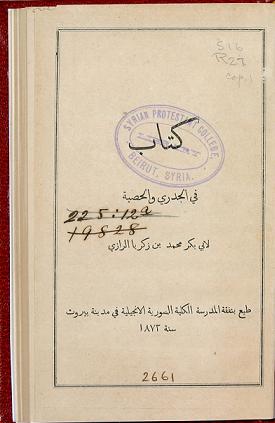
Kitab al-Judari wa al-Hasbah (The Book of Smallpox and Measles).
Kitab al-Murshid (The Guide) is a short introduction to basic medical principles that were intended as a lecture to students.
Al Shakook ala Jalinoos, (The Doubt on Galen). In this book he criticized some of Galen’s theories, particularly the four separate “humors” (liquid substances, including blood, phlegm, yellow bile and dark bile), whose balance were thought to be the key to health and a natural body-temperature. He reported that Galen’s descriptions did not agree with his own clinical observations.
Al Syrah al-Falsafiah (The Philosophical Approach).
Kitab Sirr Al-Asrar (Book of Secret of Secrets) deals with alchemy.
 | ||||||||||
| Page from Kitab Al Mansuri fi al Tibb on the morphology and anatomy of the brain (National Library of Medicine). The text in red reads: On morphology of the brain: Anatomy of the brain. The page describes in amazing detail the ventricles of the brain, as well as other observations. Al Razi utilized case histories extensively in his writing as an educational tool and as documentation of the various illnesses he diagnosed and treated. Alvarez-Millan discussed the description of diseases occurring in Kitab al-Tajārib, the largest and oldest collection of case histories, so far as is known, in medieval Islamic medical literature. Since Al Razi was a prolific medical writer, that discussion includes a review of his medical and therapeutic principles dealing with eye diseases, as described in his learned treatises, and a comparison with those therapies actually employed in his everyday practice. 4 Rhazes made important contributions to neurology and neuroanatomy. He stated that nerves had motor or sensory functions, describing 7 cranial and 31 spinal cord nerves. He assigned a numerical order to the cranial nerves from the optic to the hypoglossal nerves. He classified the spinal nerves into 8 cervical, 12 thoracic, 5 lumbar, 3 sacral, and 3 coccygeal nerves. In his clinical case reports cited in his books Kitab al-Hawi and Al-Mansuri Fi At-Tibb, he showed an outstanding clinical ability to localize lesions, prognosticate, and describe therapeutic options and reported clinical observations, emphasizing the link between the anatomic location of a lesion and the clinical signs. Al Razi was a pioneer in applied neuroanatomy. He combined a knowledge of cranial and spinal cord nerve anatomy with an insightful use of clinical information to localize lesions in the nervous system.5 In addition, he is credited as the first physician to clearly separate and recognize concussion from other similar neurological conditions.6 In addition to his contributions to the neurological sciences, he was a pioneer in the treatment of mental illnesses. When he was the director of the main hospital in Baghdad, he established a special section for the treatment of the mentally ill. He treated his patients with respect, care, and empathy. As part of discharge planning, each patient was given a sum of money to help with immediate needs. This was the first recorded reference to psychiatric aftercare.7 Al Razi is considered the “original portrayer” of smallpox.8 While serving as the Chief Physician in Baghdad, he was the first to describe smallpox and to differentiate it from measles. He wrote a treatise on the subject: “Kitab al Judari wa al Hasbah”. This book was translated more than dozen times into Latin. In spite of this, it is of interest to know that European physicians continued to confuse these two illnesses until recently.9 The first monograph written on pediatrics was authored by Al Razi. It is known in Latin as Practica Puerorum. Radbill reviewed a Latin translation of this treatise, which is labeled a “Booklet on the Ailments of Children and their Care”.10 The book has 24 chapters dealing with various illnesses in newborns, infants and children. The topics covered included skin diseases, eye and ear diseases, and gastrointestinal symptoms such as vomiting, abdominal distention, diarrhea and constipation. He devoted chapters to paralysis, epilepsy and enlargement of the head (hydrocephalus). Al Razi advocated the use of honey as a simple drug and as one of the essential substances included in composed medicines.11 His contributions to pharmacology include the introduction of mercurial ointments. He developed instruments used in apothecaries (pharmacies) such as mortars and pestles, flasks, spatulas, beakers and glass vessels. There is much more to be discussed about the contributions of this great Muslim scholar to philosophy, chemistry and medicine. We can not give him justice in a short article. The more we learn about his contributions and life dedicated to medicine, the more we value our Islamic cultural and scientific heritage.  This is another article by Dr. Abdulnasser Kaadan that shows that as early as the 9th century, the well known Muslim physician al-Razi described, in his book Kitab al-Jadari wa 'l-Hasba (The Book on Smallpox and Measles), the symptoms of smallpox and measles. Furthermore, he distinguished between the two diseases, using an antecedent of the modern differential diagnosis.
Muhammad Ibn Zakariyya al-Razi was the first physician in history who described in details the symptoms and signs of smallpox and measles based on clinical examination, and he was the first who distinguished between these two diseases by putting what is called now the differential diagnosis. This was very clear in his book: The Book on Smallpox and Measles. A manuscript of this book is kept now in Leiden University Library in the Netherlands under the number 761. We have in our Institute for the History of Arabic Science in Aleppo a microfilm of this manuscript. This book was twice translated into Latin in the 18th century. This book consists of fourteen chapters. The third chapter is considered the most important of this book; it is entitled ? The chapter related to the symptoms suggesting the exacerbation of smallpox and measles’. The aim of this study is to describe this book revealing its importance in the field of history of Islamic medicine. Short Biography Abu Bakr Muhammad Ibn Zakariya al-Razi was born in al-Ray City near Tehran in 251 H / 865 CE and died there in 313 H / 925 CE. He was a well known Muslim physician and writer, whose medical writings greatly influenced the Islamic world as well as Western Europe in the Middle Ages. He wrote on almost every aspect of medicine. Al-Razi moved to Baghdad when he was forty years old, and headed many hospitals. Europe knew him under the Latinized form of his name, Rhazes. The Sultan ‘Adhud al-Dawla asked him to find a suitable place for establishing the Bimaristan al-Adhudi. He hanged pieces of meat in various places of the city and decided for the place where the putrefaction of the meat was the slowest. Al-Razi composed more than two hundred books related to medicine, pharmacy, philosophy, music and many other sciences. And he is considered the first who founded experimental science especially in the field of medicine and chemistry, given his major interest in the experimental methodology in different natural sciences. Al-Razi’s Book on Smallpox and Measles (Kitab al-Jadari wa ‘l-Hasba) Al-Razi was the first physician in history who described in details the symptoms and signs of smallpox and measles based on clinical examination, and he was the first who distinguished between these two diseases by putting what is called now the differential diagnosis. This was very clear in his Book on Smallpox and Measles. A manuscript of this book is kept now in Leiden University Library in the Netherlands under the number 761. A microfilm of this manuscript exists in the Library of the Institute for the History of Arabic Science in Aleppo. This book was edited in Arabic and gained a great popularity in Europe after that it was translated several times into Latin and other European languages, including French, English and German. According to Honka, the book was published in Europe forty times between 1498 and 1866. But the interest that surrounds this book was during the 18th century, at a time when there was much interest in the inoculation or varulation around 1720 following the description of the procedure in Turkey by Lady Mary Wortley Montagu, the wife of the Ambassador Extraordinary to the Turkish court in Istanbul.
Al-Razi began his book with a short introduction, in which he explained the direct cause for composing his treatise, as he did not find a satisfying book written by the physicians before him dealing with this subject. The book consists of fourteen chapters. The first defines the causes of the two diseases and why just few people could escape from the attack. In the second chapter al-Razi mentioned the bodies which are more susceptible to get smallpox, and the times in the year in which the disease is more common. In this regard he says that thin, hot and dry bodies are more susceptible for measles and not to smallpox, while thin, cold and dry bodies are not susceptible for both diseases, but if they are attacked by smallpox, the disease will be benign. The times in which smallpox is most probable to widespread are at the end of autumn and the beginning of spring. In severely hot and dry summers and also if the autumn was hot and dry without rain, measles would be more expected in susceptible individuals. The third chapter is the most important of the whole book. It is entitled ?the chapter related to the symptoms suggesting the exacerbation of smallpox and measles’. In this chapter al-Razi declares that before a smallpox eruption, the patient complains of continuous fever, back pain, nose itching and sleeping disorders. Then he mentions many other general symptoms and signs such as generalized pain, breathing difficulties, cough, redness in the cheeks and eyes, sore throat, dry mouth, hoarseness, headache, anxiety and sometimes syncope may be developed. Upon reviewing this text we can recognize that al-Razi clearly emphasized that smallpox is different from measles, and he declared that there are common signs for the two diseases, and other more specific signs for every disease, enabling the physician to make a differential diagnosis between them. The most probable common signs between smallpox and measles are: Continuous fever, nose itching, allergy in the body, cheek and eyes redness, sore throat, chest pain, breathing difficulties, cough, hoarseness, headache and sometimes syncope. The author says that it is not necessary that all of these symptoms and signs should appear together, as some of them may be absent. On the other hand, regarding the symptoms, which are specific for every disease, he says that back pain is more sever in smallpox, while it may be slight or absent in measles. Distress, syncope and anxiety are more prominent in measles. The fourth chapter is on the management of smallpox in general, so he indicates ten procedures which should be carried out to achieve this purpose. The fifth chapter, which is the longest chapter of the book, deals with the prevention of smallpox before the appearance of its signs, and diminishing its diffusion after the signs appear.. In this chapter al-Razi advises to perform venesection to all patients above fourteen years old, and cupping for young patients. Then his advice is to use special diets according to the patient’s condition and age. The sixth chapter is on the factors which accelerate the appearance of skin lesions in smallpox. Al-Razi says that a massage and drinking cold water could accelerate the appearance of smallpox and measles especially when the fever is severe, thus the disease will pass easily. Also he mentioned the use of many herbal drugs which may play an important role to achieve this purpose. The seventh chapter is on taking care of the eye, throat and other organs, which need to be cared for after the appearance of smallpox signs. In this chapter al-Razi explains how this care should be performed. He also draws attention for taking care of the feet and hands, as severe pain may develop resulting from sclerosis of the skin in these members. The eighth chapter is on the factors which accelerate the maturation of smallpox. Here al-Razi advises in the case where the patient is in a good condition, the physician should do his best to mature smallpox. In this case, bandages of hot water with some flowers boiled inside it are applied to the sites of the lesion. The ninth chapter is on the factors which dry or desiccate smallpox. In the case where smallpox is wet, some kinds of ointments taken from many kinds of plants like rice are applied to dry it and make it possible to be removed. The tenth chapter is on the substances which remove the crust. Al-Razi says that if the lesion became dry and a residual of crust is still dominant, the physician should look if it was thin and dry the ointment of acetic acid should be applied first several times until it completely disappears. When the lesion is located in the face, a special kind of ointment derived from peanuts should be used. If the crust is wet, the physician may carefully scrape it off without using any ointment. The eleventh chapter is on the substances, which remove the residual effect of smallpox on the eye and all the body. Here al-Razi differentiates between the residual effects of smallpox on the eye from that on the rest of the body. In the first case he indicates to use many kinds of ointments, some of them derived from animal products. If the lesions are located all over the body, many compound ointments may be used. The twelfth chapter is on the diet recommended to a smallpox patient. The patient should drink malt (barley with water) exactly as done in acute diseases. Also, peeled lentils mixed with some other juices like acetic acid, may be of beneficial effect for smallpox patients. The thirteenth chapter is on the management of bowel function. Al-Razi states that in the last stages of most cases of measles and smallpox the faeces is soft especially in measles, therefore laxatives should be avoided except in the early stages of some cases of smallpox especially when there is fever or headache. The fourteenth chapter is on the prognosis of smallpox and measles. In this last chapter al-Razi describes the signs where the prognosis is bad, and where the prognosis is good. He considered severe pain, continuous fever, insomnia, nose itching and a shining color of the eruption as signs of bad prognosis.  Figure 2. On-line publication of al-Razi’s Kitab fi ‘l-jadari on the website of the American University of Beirut, Lebanon (p. 1). Source: On-line publication of al-Razi’s Kitab fi ‘l-jadari on the website of the American University of Beirut, Lebanon (pp. 2-3). (Source) The Scientific Value of the Book 1. Al-Razi’s Book on Smallpox and Measles is considered the first one of its kind, as it gives an explanation for smallpox and measles in an isolated book. 2. In the first chapter he mentioned that the putrefying air is a contributive factor for spreading the disease. 3. In this respect, al-Razi is credited as the scholar who differentiated, for the first time in the history of medicine, between these two diseases, and described every disease separately in details, unlike all Greek and Arab physicians before him, who considered the two diseases as one disease. Many historians such as Justave Lebon, Sigrid Honka, Douglas and others recognized this priority. In this book, al-Razi differentiated between the two diseases in three places: in the second chapter, when he talked about the bodies which are more susceptible to get smallpox, and the times in the year, in which the disease is more common. Also, in the third chapter he pointed out the symptoms that suggest the eruption of smallpox and measles. In the fourteenth chapter, which is on the prognosis of smallpox and measles, he also differentiated between these two diseases. 4. He recognized the relationship between the type of the eruption in measles and the severity of the disease. 5. The opinions of al-Razi are characterized by being free of false old concepts, so it was clear that al-Razi was very keen to prescribe the treatment in detail and the kinds of food which are more suitable, as he believed that food has an important role in the treatment. 6. Al-Razi disagrees with other physicians before him in using cold water to neutralize severe fever in smallpox and measles diseases. 7. The Kitab al-judari wa ‘l-hasba provides a decisive proof that al-Razi, such as many other Muslim physicians, was not just a translator of Greek, Indian and Syriac medicine. Indeed, in addition to the very important achievement exposed in the treatise, he innovated a lot of theories and new opinions, which contributed in medicine development at that time. Harrison’s textbook of internal medicine mentioned that al-Razi was the first who described the measles disease and differentiated it from smallpox. Also, in the popular Encarta Encyclopedia (1998 edition), it is written: “Al-Razi’s personal experiences and observations as a physician make al-Hawi a landmark in the history of medicine. In his most famous work, Treatise on Smallpox and Measles, al-Razi gives the earliest known description of smallpox”. The smallpox and measles diseases were dealt with by al-Razi in several of his other medical works, as shown in the following paragraphs. Al-Hawi fi ‘l-Tibb Al-Hawi fi ‘l-Tibb is an extremely important source for our knowledge of Greek, Indian and early Arabic writings, for al-Razi was meticulous about crediting his sources. Al-Razi died before arranging fully the book, but his followers rearranged it under the supervision of Ibn al-‘Amid who was the minister of al-Hassan ibn Bouyeih. This comprehensive book on medicine, al-Hawi, was translated into Latin in 1279 under the title of Liber Continens by Faraj ben Salem, a physician of Sicilian Jewish origin, employed by Charles of Anjou to translate medical works. Later it was translated many times into Latin, and became one of the nine books relied on in teaching in the medical college library of Paris in 1395. A special part of this book, which is related to pharmacology, was still considered the first reference in Europe for a long time after the renaissance age. There is a rare manuscript of the translation of al-Hawi into Latin, written in 1282, in the French National Library in Paris. The first edition was published in Italy in 1486 under the title: Liber Dictus Elhavi, then many editions appeared, the last one was under the title: Continens Rasis in 1542. There exists a rare copy of this edition in the Cambridge Library, UK.
Al-Hawi’ is still considered the largest medical textbook edited from the Arabic language up to date, as it consists of twenty three volumes, according to the edition which was accomplished by the Othmania Publishing House in Haydarabad, India between 1955 and 1971. In the 17th volume of the book, al-Razi discussed smallpox and measles. He described the eruption of measles as a red skin maculae without protrusion into or out of the skin, while the eruption in smallpox is infiltrated into skin. Then, he mentions that the smallpox eruption appears as groups, while the measles eruption appears altogether. He considered the black and violet colors of the eruption in smallpox as bad prognosis.
A treatise on pediatric diseases (Risala fi amradh al-atfal wa ‘l-‘ianaya bhihim): Al-Razi wrote this treatise in 900 H. Most historians like Rabdill, Gustave Lebon, and Sigrid Honka consider it as the first separated book written in pediatric diseases, because al-Razi for the first time in the history of medicine separated between pediatrics and gynecology, while all other physicians before him used to gather the two subjects in one book. Unfortunately, the original Arabic version of this book seems to be lost. In the past it was translated into Hebrew then into Latin between 1114 and 1187, and it was published many times. Lately, Pieper translated many chapters into German, and Ruhra accomplished another translation into English, then the entire treatise was translated into Italian. Recently, Dr. Samuel Rabdill put a new English translation of this treatise and published it in the American Pediatric Journal (n° 5, vol. 122, 1971). This translation is considered now the best version. Dr. Mahmood Haj Kasem from Iraq translated it into Arabic. The treatise contains twenty-four chapters discussing many pediatric diseases and their treatment. Among these diseases smallpox and measles were discussed. Also, many other pediatric diseases were described such as tinea, scabies, hydrocephalous, abdominal enlargement, sneezing, insomnia, epilepsy, ear discharges, eye diseases, teeth diseases, mouth ulceration, vomiting, diarrhea, cough, worms, umbilical protrusion, hernia, urethral stone, and poliomyelitis. In addition to the historical importance of this treatise it has a scientific importance, as it contains new opinions and theories related to pediatric diseases. The effect of al-Razi concepts related to smallpox and measles on the physicians after him It is well known that during the time of al-Razi, books were not written and widely published like in our time, but there were only some manuscripts available for some scholars for every book. Therefore, we can expect that many Muslim physicians after al-Razi’s time did not mention the master’s concepts regarding smallpox and measles. I would like here to trace the effect of al-Razi concepts in this issue on the Muslim physicians after him. Ali ‘ibn Abbas al-Majusi: He died in 994 (about 70 years after al-Razi). In the fourteenth chapter of the first volume of his book Kamel al-Sina’a al-Tibiya, he talked about smallpox. He considered smallpox and measles as one disease. This means that al-Majusi had no idea about al-Razi writings in this regard, or his pride prevented him to quote from al-Razi’s book. Ibn Sina: He lived about one hundred years after al-Razi. Upon comparison between what was written by Ibn Sina in his book al-Qanun fi ‘l-ttib (The Canonof Medicine) with al-Razi’s writings on smallpox and measles, it is clear that Ibn Sina quoted a lot of information from al-Razi. In the third book of al-Qanun, he devoted a special part to deal with smallpox and measles. Ibn Sina differentiated between the two diseases and said they have common signs, and other signs specific for every disease. Then he described the skin eruption of every disease, resembling that written by al-Razi. But Ibn Sina did not mention that he had quoted from al-Razi’s writings. Ibn Zuhr: He lived in al-Andalus and died there in 1162. His book is entitled Al-Taysir fi ‘l-Mudawati wa-‘l-Tadbir. It was translated into Hebrew then into Latin, and published many times under the name of Facilicito Adjumentum. In the second volume of the book, ibn-Zuhr devoted a chapter to smallpox and measles, and he considered them as one disease. It is clear that Ibn Zuhr did not quote from Ibn Sina’s or al-Razi’s writings regarding smallpox and measles, especially if we know that al-Qanun was well known in al-Andalus during that time. Ibn al-Nafis: He was born in Damascus and died in Cairo in 1288. His book is entitled al-Mujaz fi al-tib (The Concise Book in Medicine). It is considered as a revision of Ibn Sina’s Canon. Therefore, ibn al-Nafis repeated briefly what Ibn Sina had exposed about smallpox and measles, and he differentiated between the two diseases. But, it is worth mentioning that ibn al-Nafis did not mention the back pain as a differential sign of smallpox. Dawud al-Antaki: He was born in Antakia and died in Mecca in 1599. His medical book, known as Tadhkirat Dawud (Memoir of Dawud), has a longer title: Tadhkirat Uli al-albab wa ‘l-Jami’ li-l-‘ajab al-‘ujab. In the first part of this book he describes the signs of measles and smallpox in a way very like that described by al-Razi. In addition, he differentiated between the two diseases. In the same chapter he talked about chicken pox, and considered it as a benign form of smallpox. Madian al-Qawsuni: He was an Egyptian physician who lived in the 17th century. His medical book is entitled Qamus al-atiba wa namuus al-aliba (The Physician’s Dictionary). In the first chapter of the book, where he dealt with measles, he described the signs of measles and smallpox, mentioning that he quoted it from Ibn Sina’s Canon. He differentiated between the two diseases saying that the lesion in measles is small, thin and does not extend outside the skin, while smallpox lesion is protruded outside the skin and thick. Conclusion No doubt that al-Razi was the first physician in the history of medicine who differentiated between smallpox and measles, and considered them as two diseases. The influence of his concepts in the diagnosis of these diseases on the Muslim physicians was very clear, especially on Ibn Sina, ibn al-Nafis, al-Antaki and al-Qawsuni. But it is worth mentioning that the majority of these physicians have quoted their information in this regard from The Canon of Ibn Sina, as it was the book that knew the widest diffusion and exerted the largest influence in the east as well as in the west. At the end, I would like to conclude this presentation by a word of truth, written by the European Doctor De Poure, who declared: “Medicine was absent till Hypocrites created it, dead till Galen revived it, dispersed till Rhazes collected it, deficient till Avicenna completed it”. |



REFERENCES
- 1.El Gammal SY. Rhazes contribution to the development and progress of medical science. Bull Indian Inst Hist Med Hyderabad. 1995;25(1–2):135–149. [PubMed] [Google Scholar]
- 2.Ammar S. Abû Bakr ibn Zakaria Er-Razi (Rhazès): the greatest Arabo-Islamic physician and one of the most famous who knew humanity. Tunis Med. 1985;63(12):663–675. [PubMed] [Google Scholar]
- 3.Richter-Bernburg L. Abu Bakr Muhammad al-Razi’s (Rhazes) medical works. Med Secoli. 1994;6(2):377–392. [PubMed] [Google Scholar]
- 4.Alvarez-Millan C. Practice versus theory: tenth-century case histories from the Islamic Middle East. Soc Hist Med. 2000;13(2):293–306. doi: 10.1093/shm/13.2.293. [DOI] [PubMed] [Google Scholar]
- 5.Souayah N, Greenstein JI. Insights into neurologic localization by Rhazes, a medieval Islamic physician. Neurology. 2005;65(1):125–128. doi: 10.1212/01.wnl.0000167603.94026.ee. [DOI] [PubMed] [Google Scholar]
- 6.McCrory PR, Berkovic SF. Concussion: the history of clinical and pathophysiological concepts and misconceptions. Neurology. 2001;57(12):2283–2289. doi: 10.1212/wnl.57.12.2283. [DOI] [PubMed] [Google Scholar]
- 7.Daghestani AN. Images in psychiatry: al-Razi (Rhazes), 865–925. Am J Psychiatry. 1997;154:1602. doi: 10.1176/ajp.154.11.1602. [DOI] [PubMed] [Google Scholar]
- 8.Behbehani AM. Rhazes. The original portrayer of smallpox. JAMA. 1984;252(22):3156–3159. doi: 10.1001/jama.252.22.3156. [DOI] [PubMed] [Google Scholar]
- 9.Cunha BA. Smallpox and measles: historical aspects and clinical differentiation. Infect Dis Clin N Am. 2004;18(1):79–100. doi: 10.1016/S0891-5520(03)00091-6. [DOI] [PubMed] [Google Scholar]
- 10.Radbill SX. Classics from medical literature IV. The first treatise on Pediatrics. Am J Dis Child. 1971;122(5):369–376. doi: 10.1001/archpedi.1971.02110050039001. [DOI] [PubMed] [Google Scholar]
- 11.Katouzian-Safadi M, Bonmatin JM. The use of honey in the simple and composed drugs at Rhazés. Rev Hist Pharm (Paris) 2003;51(337):29–36. [PubMed] [Google Scholar]
– Al-Baba M.Z., History and legislation of pharmacy, Damascus: Damascus University, 1986, p. 344.
– Ibn Sina, Al-Qanun fit-Tibb. Beirut: Dar Sader, 1980, vol. 3, p. 197.
– Honka, Zigrid, Shamsu ‘l-‘Arab Tasta’u ‘ala al-Gharb, 2nd edition, Beirut, 1969.
– Al-Majusi, Kamel al-Sina’a al-Tibiyya, Cairo, 1918.
– Al-Razi, Kitab al-Jadari wa ‘l-Hasbah, Italy, 1766.
– Al-Razi, Al-Hawi, Haydarabad, India, 1955-1976.
– Al-Razi, Kitab fi al-Jadari wa ‘l-Hasbah. Printed at the expense of the Syrian Evangelical College of the city of Beirut. Beirut, 1872.
– Savage-Smith, Emilie, Islamic Culture and Medical Arts, Bethesda (Maryland): National Library of Medicine, 1994.
* Dr. Abdul Nasser Kaadan is the Chairman of History of Medicine Department, Aleppo University, Aleppo – Syria. He is also the President of the International Society for the History of Islamic Medicine ISHIM (www.ishim.net).
Dr. Kaadan has been awarded by the Syrian Government the Bassel al-Assad Prize in the field of History of Medical Research Dr. Kaadan, who is an orthopedic surgeon since 1986, received his PhD in History of Medicine in 1993 from the Institute for the History of Arabic Science in Aleppo.
Address: P.O. Box 7581, Aleppo, Syria. E-mail: a.kaadan@scs-net.org.


No comments:
Post a Comment